Buying a Home? What a Level 2 Chimney Inspection Finds
Chimney Sweep Cornwall NY · Updated September 2026 · All chimney advice
A general home inspection is not a chimney inspection, and most home inspectors say so in their own reports. If the house you are buying has a chimney, that is a separate piece of work — and the standard actually calls for it.
Why a property sale triggers one
NFPA 211 defines three levels of chimney inspection, and a Level 2 is specified when a property changes ownership. The reasoning is straightforward: the new owner has no history with the system. Nobody can tell them whether there has been a chimney fire, what the appliance used to be, whether the flue was ever relined, or what the last person did to it. A Level 2 establishes the condition independently.
The same level applies when the fuel changes, when the appliance is replaced, when the flue is altered, and after a chimney fire or a weather event — all situations where the system's history stopped being reliable.
What a home inspector does and does not cover
A home inspector looks at the chimney the way they look at everything else: visually, from accessible positions, within a limited time. They will note obvious exterior deterioration, a missing cap, staining, and whether the damper operates.
What they do not do is put a camera up the flue. And the flue interior is where the defects that cost real money live.
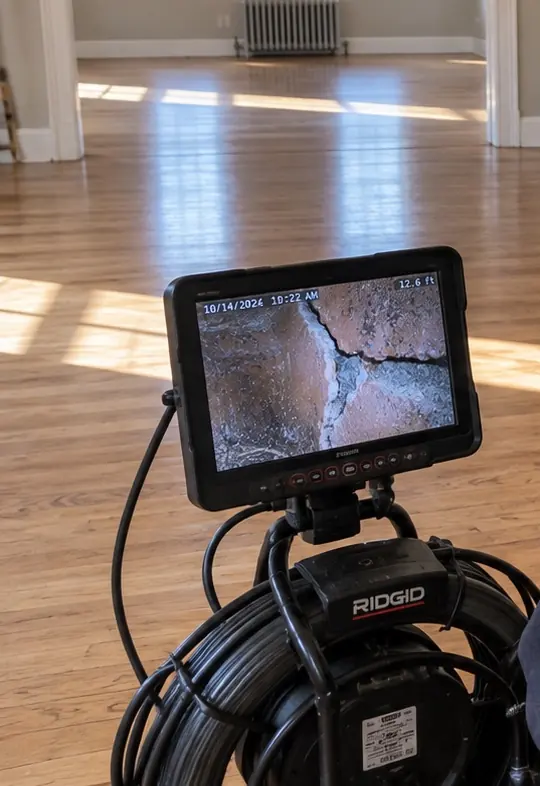
What the camera scan finds
A Level 2 inspection includes a video scan of the full length of every flue. These are the things it turns up that nothing else will:
- Cracked clay tiles. Usually from a previous chimney fire or thermal shock. Invisible from both ends of the flue.
- Missing or washed-out mortar joints between tiles. Each gap is an opening from the flue into the chimney structure and whatever it touches.
- Breaches between adjacent flues. In a multi-flue stack, a connection between two flues is a carbon monoxide pathway from one appliance to another part of the building.
- No liner at all. Common in older housing here. Normal when built; not adequate for a modern appliance.
- Unfinished or improper previous work. A liner that stops short, an unsealed connection, a repair abandoned partway.
- Obstructions. Nests, debris, collapsed tile, or a flue blocked by a previous alteration nobody documented.
It also covers accessible portions of attics, crawl spaces and basements the chimney passes through — which is where you find out whether flue gases have been reaching framing and insulation.
What this is worth to a buyer
Two things. First, safety: a breached flue on a house you are about to move into and light a fire in is not a cosmetic issue. Second, negotiation: a defect found before closing is a line item in the discussion. The same defect found in November is entirely your problem.
Chimney work sits at the expensive end of home repairs — relining and masonry rebuilding are not small jobs — so this is not a minor line on the inspection list.
Local things worth knowing
If you are buying around Cornwall and the surrounding river towns, a few conditions come up often enough to be worth anticipating:
- Housing here skews older than the national average, and older chimneys are more likely to be unlined or to have clay tile that has been through a lot of winters.
- Oil and propane heating are common, so the chimney is often venting a furnace or boiler rather than just a fireplace — that flue matters daily through the winter.
- If the heating system has been replaced recently, ask whether the flue was relined at the same time. It frequently should have been and frequently was not.
- A wood stove installed into an existing fireplace opening is common and often done without addressing the flue size.
- Freeze-thaw damage to exposed masonry is normal here rather than exceptional. What stage it has reached is what matters.
Getting it done
Book it during the inspection period rather than after. If the house has more than one flue, say so — each one is scanned separately and it changes how long the visit takes.
Our chimney inspection is $69. If the scan turns something up, you will get it explained in terms you can actually take back to the negotiation — what it is, what causes it, and whether it is a safety issue or a maintenance item.