Do You Need a New Chimney Liner When You Replace a Furnace?
Chimney Sweep Cornwall NY · Updated September 2026 · All chimney advice
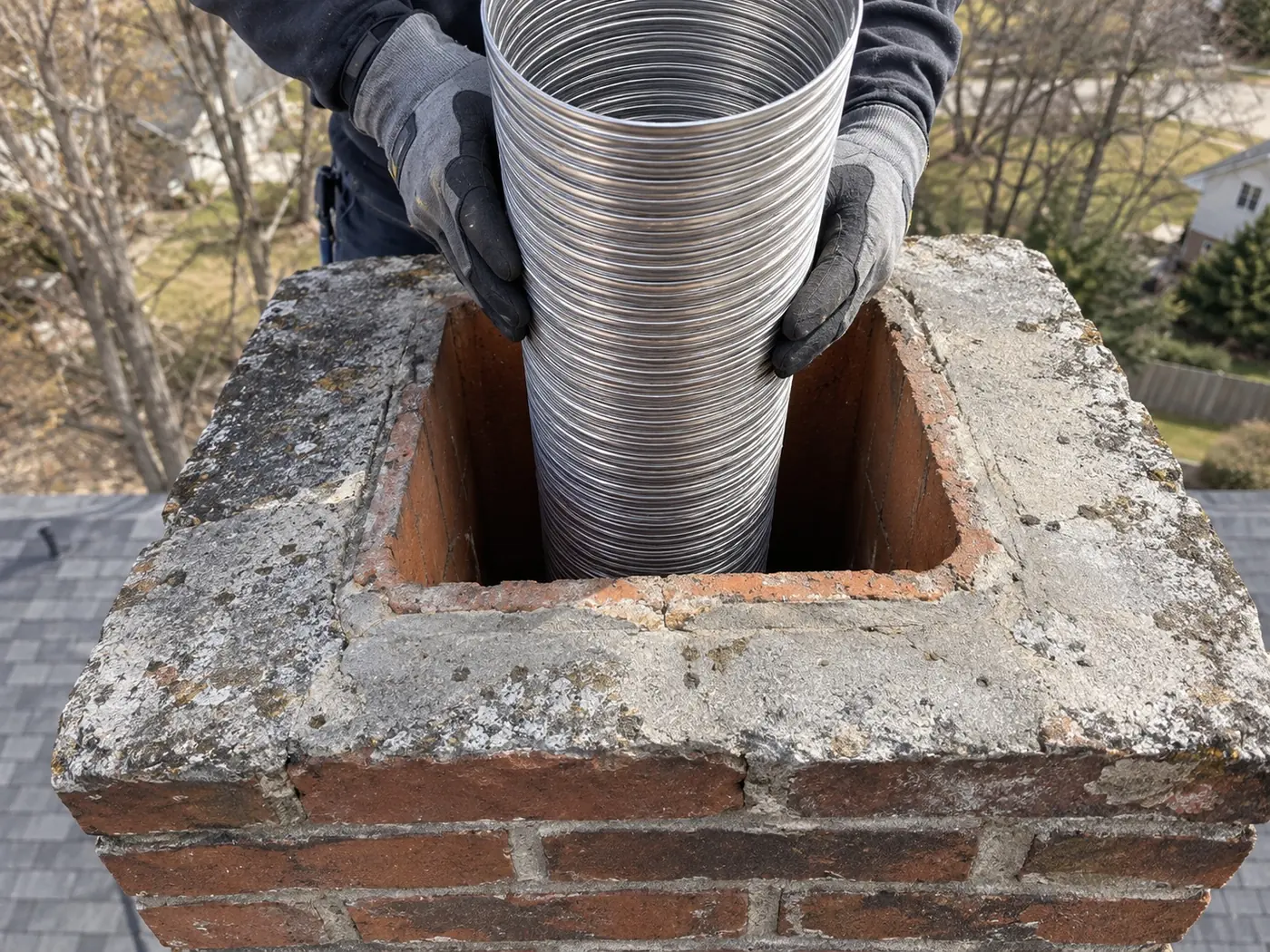
Frequently yes — and for a reason most homeowners are never given. The counter-intuitive part is that a better furnace can be harder on your chimney than the one it replaced.
The short version
A chimney flue has to be sized for the appliance attached to it. A modern high-efficiency furnace or boiler sends much less heat up the flue than an older unit, because that is what efficiency means — more heat into the house, less out of the top. Put an efficient appliance on a flue sized for an inefficient one and the flue is now far too large for it.
An oversized flue does not simply work less well. It actively damages the chimney.
What goes wrong in an oversized flue
Flue gases need to stay above their condensation temperature all the way up. In a flue that is too large, the same volume of gas has more cold surface area to give heat up to and travels more slowly. It cools. Below the dew point the water vapour in it condenses on the flue wall.
That condensate is not clean water. Combustion products make it acidic, and it does three things:
- Dissolves the mortar joints between clay flue tiles, from the inside where nothing shows
- Soaks into the masonry, then freezes through the winter and spalls it from within
- Corrodes any metal in the system — connectors, dampers and unsuitable liner material
Meanwhile the draft is weaker because the gases are cooler, which makes the whole problem self-reinforcing. Homeowners often notice nothing at all until white staining appears on the outside of the chimney, or pieces of tile turn up in the base.
Four situations that need the flue looked at
1. Straight furnace or boiler replacement
New appliance, same fuel. The efficiency jump alone is usually enough to make the existing flue oversized. This is the most common case and the one most often missed, because from the homeowner's point of view nothing about the chimney changed.
2. Fuel conversion
Oil to gas, or gas to something else. Flue gas temperature, volume and chemistry all change. The existing flue is rarely appropriate afterwards. A fuel change is one of the specific triggers for a Level 2 inspection under NFPA 211.
3. The orphaned water heater
This one is worth watching for. When a furnace is upgraded to a direct-vent unit that vents out through a wall, the gas water heater is often left behind, still venting into the masonry chimney on its own. A flue that was marginal for a furnace and a water heater together is enormously oversized for one small water heater by itself. Its flue gases barely get moving before they cool and condense.
4. A wood stove into an existing fireplace
Not a furnace, but the same principle. A stove is a much smaller, more controlled heat source vented into a flue built for an open fireplace. Without a correctly sized liner it runs cool, drafts poorly and produces considerably more creosote.
Why this comes up so often around here
Oil and propane heating are common across this part of the Hudson Valley, which means a large number of houses have a heating appliance venting into a masonry chimney rather than a modern direct-vent system. Combine that with housing stock that is older than the national average and chimneys that have already been through several heating systems, and furnace replacement becomes the single most common real reason a chimney here needs relining.
What to do about it
The right moment is before the old appliance comes out, not after the new one has spent a winter condensing into the flue.
-
Ask what flue size the new appliance requires
The installation instructions specify it. It is a straightforward question and the heating contractor will have the answer.
-
Have the existing flue assessed
Size, material, condition and whether anything else vents into it. A camera scan shows the joints and tile condition that cannot be seen from either end.
-
Reline if the sizes do not match
An appropriately sized stainless liner, insulated where the application calls for it, gives the new appliance the flue it was designed for and protects the masonry from its own exhaust.
If you have already had the work done and nobody mentioned the chimney, it is worth checking now rather than at the end of the season. Have the flue inspected, and the liner page explains sizing in more detail.